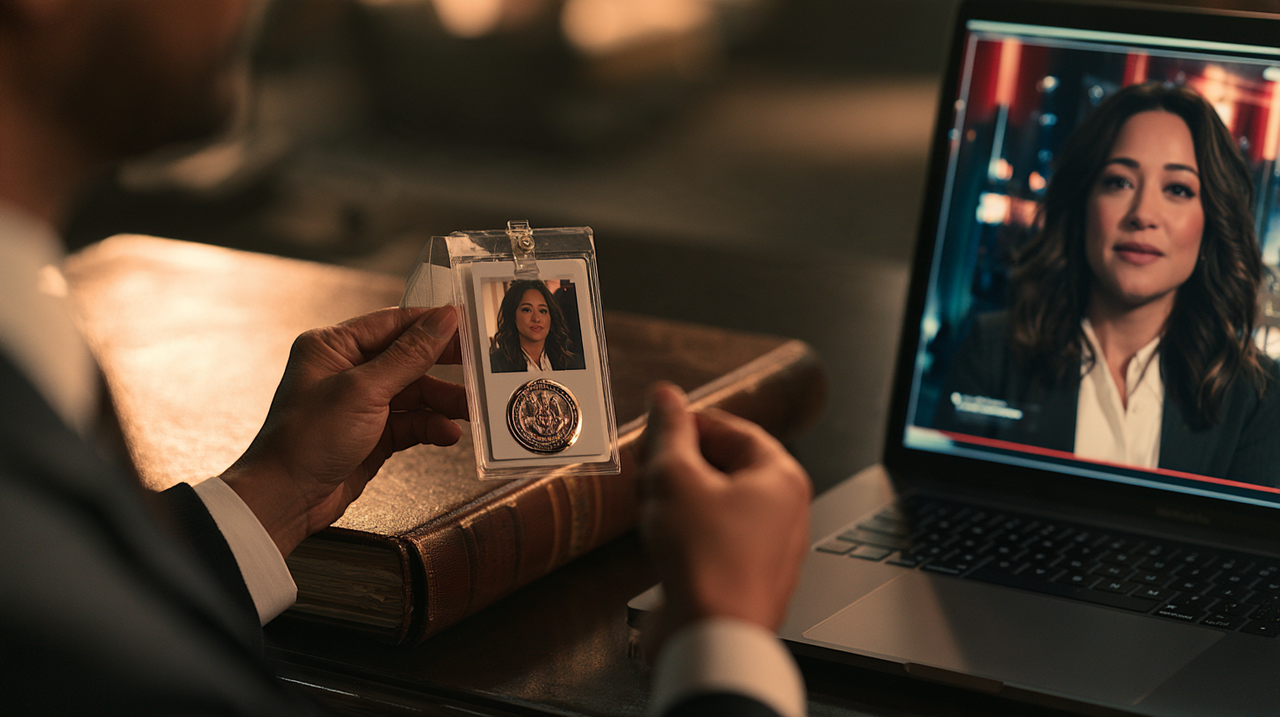
In early May 2026, someone in Auckland scrolled past something on Facebook that did not look like an advertisement. It looked like a news segment. There was Mike McRoberts, one of the most recognisable faces in New Zealand television journalism, apparently conducting an interview. Opposite him sat a woman in clinical dress, identified as Dr Divya Perumal, a New Zealand-trained ophthalmologist specialising in glaucoma and cataract surgery. She was describing a product she had developed, a treatment that could reverse conditions medicine has spent a century failing to reverse. Glaucoma. Cataracts. Dementia. And she was explaining, in the calm register of a professional finally telling the truth, that the medical industry was a cartel that did not want you to know.
None of it had happened. The viewer was watching a synthetic composite, built from the scraps of footage that exist of any working specialist in the public domain, a conference talk, a clinic video, an interview, and used to drive a generated face and a cloned voice. The barrier to entry is now measured in dollars and minutes rather than expertise. It was good enough that a stranger felt moved to warn her.
What happened next ought to concern everybody. Perumal did what a reasonable person does. She contacted the New Zealand Police. She contacted Netsafe, the country's designated online safety agency. She contacted Ophthalmology New Zealand and the Royal Australian and New Zealand College of Ophthalmologists, the bodies that certify her competence and to whom she is accountable. And she tried to report the advertisement to Meta, whose platforms were distributing it and taking money to do so. She could not make the report stick. The advertisement was served as a paid promotion without a conventional Facebook post URL, and Meta's reporting flow wanted a URL. The form had no box for the thing happening to her. Writing in New Zealand Doctor on 29 July 2026, under the headline “Medical deepfakes target the vulnerable and degrade trust”, Perumal set out what the experience had taught her about her patients and about the machinery supposed to protect them. She has called it a public safety risk. That is not hyperbole. It is a clinical assessment.
Here is what a glaucoma specialist knows that the rest of us do not. Glaucoma is silent, irreversible optic nerve damage. The treatment is drops, laser or surgery, applied forever, and the whole clinical battle is against non-adherence, because the drops are fiddly and the disease does not hurt until it is too late. A patient who stops their drops because a woman who looks and sounds exactly like their consultant has said the industry is a cartel and this bottle will fix it does not get a second chance. The sight does not come back. This is not a scam in the sense that a fake concert ticket is a scam. It is a delivery mechanism for permanent harm, wearing a real doctor's face while it works.
Why Doctors Are the Perfect Mark
The choice of target is not accidental, and it is not new. In July 2024 The BMJ published an investigation, carried out with the retired Essex physician John Cormack, into the deepfaking of Britain's most trusted television doctors. Hilary Jones, Rangan Chatterjee and the late Michael Mosley were all found puppeted across Facebook and Instagram to sell purported fixes for high blood pressure and diabetes and to shift hemp gummies. Cormack's point was brutally economic: it is far cheaper to make videos than to do research, develop a product and bring it to market conventionally. Trust is the most expensive thing in medicine and the cheapest thing to counterfeit.
Australia followed. In December 2024, Jonathan Shaw, deputy director of the Baker Heart and Diabetes Institute in Melbourne, appeared in a fabricated interview with the breakfast host Karl Stefanovic, in which a synthetic version of him declared metformin was not enough to manage type 2 diabetes and that clinicians still prescribing it were idiots. The institute fielded dozens of calls, and a good number of Shaw's patients had seen it. Earlier that year, deepfakes of the science communicator Karl Kruszelnicki endorsing blood pressure pills ran across hundreds of advertisements on Facebook and Instagram.
By August 2025, CBS News, working with the security firm ESET, had documented dozens of accounts and more than 100 videos across TikTok, Instagram, Facebook and YouTube in which fictitious or impersonated doctors dispensed advice and sold products, many viewed millions of times. Among the impersonated was Joel Bervell, the physician and medical educator known online as the Medical Mythbuster. His reaction is the one every victim describes. It looked like him. It did not sound like him. The viewer, of course, has no baseline for the second half. The problem intensified rather than abated: in October 2026 the Delhi High Court permanently restrained social-media accounts from using the name, image, voice and likeness of the cardiac surgeon Dr Devi Shetty in AI deepfake videos promoting fake diabetes and blood-pressure cures, making absolute an earlier order that required Meta and Google to take the content down and to disclose the details of the accounts behind it.
Then there is the end of the chain, where the money and the harm land. Beth Holland lives with lipedema, a chronic condition of abnormal fat accumulation, swelling and reduced mobility affecting an estimated 17 million American women. Scrolling Facebook, she found an advertisement for a cream called Svelta Venastra, promoted by a deepfake of her own doctor. She paid 300 dollars. It did nothing. Her credit card company refunded her as fraud, which makes her one of the lucky ones. Speaking to TODAY, she summarised the industry that produced the advertisement in a sentence: it is terrible that they scam people who are desperate and in pain.
The American Medical Association reached the same conclusion by a different route. On 29 April 2026 it published a policy framework, developed by its Center for Digital Health and AI, built on seven principles. A physician's name, image, likeness, voice and digital replicas are protected rights, not transferable assets a health system or vendor may treat as furniture. Deceptive medical impersonation should be prohibited outright. Consent must be opt-in, specific as to purpose, audience and duration, and revocable. Synthetic content depicting physicians must be labelled and watermarked. Prevention is shared among platforms, hospitals and vendors, including rapid takedown and a ban on synthetic content using professional titles. There must be practical enforcement routes and audit logs. And, crucially, monitoring must not fall on individual doctors. AMA chief executive John Whyte put the case in terms no trade body uses lightly, arguing these are not just scams but a public health and safety crisis, in which bad actors exploit a doctor's identity, undermine patient trust and steer people towards harmful, unproven care.
What Verification Actually Costs a Frightened Person
The reflexive answer is that patients should be more careful. Check the source. Look for artefacts. Verify before you buy. The security researcher Tony Anscombe of ESET offered the canonical formulation to CBS News: trust nothing, verify everything. As advice to a corporate security team, this is sound. As a duty imposed on a person with a chronic disease at eleven o'clock at night, it collapses under the weight of the evidence.
Start with the raw perceptual question. In February 2025 the biometric firm iProov tested 2,000 consumers in the United Kingdom and the United States on real and synthetic images and videos. One tenth of one per cent identified every item correctly. More revealing was the confidence data: participants reported roughly 60 per cent confidence whether right or wrong. They were not uncertain. They were wrong and comfortable.
That is one commercial study, so consider the academic literature. A systematic review and meta-analysis published in late 2024, pooling 56 papers and 86,155 participants across audio, image, text and video, found overall human detection accuracy of 55.54 per cent, with confidence intervals crossing 50 per cent, meaning performance was not reliably distinguishable from chance. For high-quality video deepfakes, detection fell to 24.5 per cent, worse than guessing. There is no version of the evidence in which ordinary perception is an adequate defence.
Now add the health context. The 2003 National Assessment of Adult Literacy, still the most comprehensive survey of its kind in the United States, found just 12 per cent of adults had proficient health literacy and 14 per cent were below basic. In England, a longitudinal study of 7,857 adults aged 52 and over, published in The BMJ in 2012 by Sarah Bostock and Andrew Steptoe, found roughly a third could not fully understand instructions on a medicine label, and that those in the lowest health literacy band were more than twice as likely to die within five years as those in the highest. The population least equipped to parse a synthetic endorsement is precisely the population most likely to be shown one.
Then there is whether people can tell authoritative medical content from generated medical content at all. In August 2024 a team at MIT comprising Shruthi Shekar, Pat Pataranutaporn, Chethan Sarabu, Guillermo Cecchi and Pattie Maes ran that experiment with 300 participants. They could not reliably distinguish physician-written responses from those generated by a large language model, and rated the accurate machine answers as more valid, more trustworthy and more complete than the doctors'. The low-accuracy machine responses, flagged by physicians as wrong, performed roughly as well as real doctors' answers, with participants indicating a high willingness to act on potentially harmful advice. Trust was not tracking accuracy. It was tracking fluency and the appearance of authority, which is exactly what a deepfake manufactures.
Nor can the patient outsource the problem to a chatbot. In work posted in October 2025 and accepted to CHI 2026, Anku Rani, Valdemar Danry, Paul Pu Liang, Andrew Lippman and Pattie Maes tracked 67 participants over a month assessing news items with AI assistance. Accuracy rose 21 per cent on average while the assistance was present. Then it fell: unassisted performance on new items dropped 15.3 per cent by week four against baseline. The tool that helps in the moment erodes the faculty you need when it is absent.
Set these findings alongside one another and the asymmetry is impossible to argue away. Generating a convincing medical deepfake costs a few dollars, takes minutes, requires no domain knowledge, and can be replicated across thousands of variants aimed at people whose scrolling has already marked them as glaucoma patients or diabetics or cancer sufferers. Verifying one costs the patient a search of a register they may not know exists, a comparison against authentic footage they cannot source, and an understanding of synthetic media artefacts the meta-analysis says they will get wrong three times in four. The generation side scales. The verification side does not scale at all, because it must be performed anew by each individual, at their own cost, using faculties the evidence says they do not possess.
The informed consumer model presupposes rough parity of information and effort. Here there is none. A person newly diagnosed with a degenerative eye condition is not a rational actor conducting due diligence in a marketplace. They are frightened, holding a prognosis and looking for hope, and the advertisement has been engineered, using the platform's own targeting infrastructure, to find them at exactly that moment. Placing the verification duty on that person is not a policy. It is an abdication dressed as a principle. The reasonable expectation of a patient is ordinary scepticism: do not send money to strangers, discuss anything new with your own clinician first. That is where their duty ends, and it ends there because it can go no further.
The Business Model That Pays for the Fake
If the patient cannot bear the burden, the next question is who can. The platforms are the obvious candidate, and not merely because the content sits on their servers. They are the candidate because they are paid.
Much of the argument around Section 230 of the US Communications Decency Act, and its equivalents elsewhere, concerns organic user speech, the post someone writes and someone else reads. Medical deepfake advertising is a different animal. It is a commercial transaction in which the platform takes money, applies its own targeting apparatus to find the most receptive audience, and delivers the content to them. The platform is not a passive conduit. It is a party to the transaction, and it profits per impression.
In November 2025, Reuters reported on internal Meta documents dated between 2021 and 2025. The company had projected that around 10.1 per cent of its annual revenue, roughly 16 billion dollars, came from advertisements promoting scams and banned goods, a category expressly including banned medical products alongside illegal gambling and fraudulent investment schemes. It estimated about 7 billion dollars in annualised revenue from higher-risk scam advertisements in 2024 alone, and calculated it was serving in the order of 15 billion of them a day. The documents indicated an internal playbook for managing regulatory pressure, and reluctance to impose universal advertiser verification because of the revenue impact. Meta disputed the characterisation, calling the 10 per cent figure overly inclusive.
Even taking the objection at face value, the structural point survives. Universal advertiser verification was considered and weighed against revenue. That is the disclosure that matters, because it is precisely the intervention that would have stopped the advertisement Divya Perumal could not report.
The current model is reactive takedown, and reactive takedown has already lost. Perumal, backed by two professional colleges and a national online safety agency, could not get a single advertisement removed. In the CBS investigation, TikTok and Meta removed flagged videos while YouTube declined, saying the content did not violate its Community Guidelines. TikTok's own figure, that it removed 94 per cent of violating AI-generated content in a quarter, sounds impressive until you note that the denominator is unbounded and the marginal cost of the next variant is close to zero. Against a generative adversary, a 94 per cent removal rate is not a defence. It is a tax the fraudster has already priced in.
A serious platform duty is neither mysterious nor technically hard. Health advertising should be a restricted category requiring verified advertiser identity before a single impression is served, as financial services advertising already is in several jurisdictions after the same lesson was learned the hard way. Any advertisement depicting an identifiable individual as a medical professional should require documented authorisation from that individual or their institution, checked before publication rather than after complaint. Reporting channels must accept a report of impersonation without demanding a URL the format does not generate. And there should be a strict liability rule for revenue: a platform that has taken money to distribute an impersonation of a clinician disgorges that revenue and pays statutory damages, regardless of what its systems knew. Attaching the consequence to the money rather than to knowledge removes the incentive to design systems that carefully avoid knowing. None of that touches organic speech. It touches only paid inventory, the part the platform controls absolutely.
The Registers That Know Who Is Real
A second institution has a claim to act here, and it has been curiously quiet.
Every jurisdiction with a functioning medical system maintains an authoritative, publicly searchable register of licensed practitioners: the General Medical Council in the United Kingdom, the Medical Council of New Zealand, the state medical boards in the United States, the specialist colleges certifying subspecialty competence. These bodies hold the most valuable dataset in the entire problem, the ground truth of who is a real doctor, what they are qualified in, and where they practise. No platform has that. No AI company has it. The registers have it, and maintain it as a statutory function.
They are, in other words, the natural verification substrate for medical identity online. And they are almost entirely absent from the response, for reasons structural rather than negligent. A medical regulator's remit is protecting the public from its members. Its machinery is built for complaints, investigations, fitness-to-practise hearings and erasure from the register: an apparatus of discipline pointed inwards at the profession. It has no doctrine, no budget line and often no legal standing for the opposite task, defending a member's identity against a third party who has stolen it. When Perumal turned to her college and her professional association, she was asking institutions built to judge her to instead protect her, and they were not constructed for it.
The consequence is that the doctor litigates alone. She must discover the fake herself or be told by a stranger, document it, report it through channels not designed for her, and absorb the reputational damage, all while running a clinical practice. This is precisely the failure the seventh AMA principle identifies when it insists identity protection be an institutional default rather than a monitoring obligation carried by individual physicians. The principle is right. What is missing is a body willing to own it.
An affirmative duty to defend member identity has four components, none requiring new technology. First, the register becomes machine-readable and cryptographically attestable, so any platform or verification service can ask in real time whether a named individual is a registered practitioner and in what specialty, and receive a signed answer. That turns the register from a website a patient must know to visit into infrastructure others can build on. Second, the regulator offers registrants an authenticated identity credential bindable to genuine content they produce, so the authentic article carries a verifiable mark and the counterfeit does not. Third, the regulator or college acquires legal standing to issue takedown demands on a member's behalf, and the resources to do so at volume, so a national body with lawyers negotiates with Meta rather than an exhausted ophthalmologist with a web form. Fourth, it monitors proactively for impersonation, because it is the only actor with both the complete list of names and an interest in the integrity of the profession as a whole.
There is a legitimate objection: regulators are funded by registration fees, are already stretched, and expanding their remit from discipline to defence changes their relationship with the profession they police. The straight answer is that the register is a public good and its integrity a public interest. When counterfeit currency circulates, we do not tell shopkeepers to litigate against forgers. The central bank that issues the currency owns the problem of its authenticity. Medical registration is a credential issued by a public body, and its value to patients depends entirely on its not being forgeable. Defending it is not an expansion of the regulator's mission. It is the same mission viewed from the other side.
The Toolmakers Who Say They Are Only Tools
Then there are the companies that make the cloning possible, whose standard defence is that a general purpose technology cannot answer for particular misuse. A hammer can break a window.
The analogy fails for a specific reason. A hammer's capability is to apply force; breaking a window is incidental. A voice cloning system's capability is to reproduce a specific human being's voice such that listeners believe it is them. Impersonation is not a misuse of the tool. It is the function of the tool. When the capability you sell is the reproduction of identity, you cannot invoke neutrality about identity.
To their credit, the established providers acknowledge some version of this. ElevenLabs, among the most widely used voice synthesis platforms, distinguishes instant cloning, where the user must confirm they hold the rights and record a verbal consent statement, from professional cloning, which adds a verification step before training. It prohibits unauthorised impersonation, removes clones on report, and cooperates with enforcement. That is better than nothing. It also stops only casual misuse: a consent statement can be recorded by anyone, and a policy enforced on report is a reactive control facing the same volume problem as platform takedown.
The provenance layer is in better shape than it was, and still not close to sufficient. The Coalition for Content Provenance and Authenticity passed 6,000 members and affiliates by January 2026, and its Content Credentials standard is supported to varying degrees across major platforms: Meta reads C2PA data on upload and applies AI Info labels, TikTok labels generated content where credentials are present, X added credential display for Premium users in March 2026, and LinkedIn is among the few services preserving credential chains through upload. The unresolved problem is that the internet's standard image and video pipelines strip embedded metadata during transcoding, not out of malice but because they were built to minimise file size. Signing content has become easy. Ensuring the signature survives the journey to the viewer has not. Invisible watermarking is no complete answer either. Research published in August 2025 assessing Google's SynthID text watermarking found it degradable by paraphrasing, back-translation and simple character-level edits, the general pattern being that the more robust the mark, the more it degrades the output.
Regulation has arrived, unevenly. Article 50 of the EU AI Act, the transparency provision, has applied since 2 August 2026. The Commission published draft guidelines on 8 May 2026 and adopted the final guidelines on 20 July 2026, as C(2026) 5054 final. The labelling obligation is broad: content that looks or sounds like a real person must be marked even absent intent to deceive. The machine-readable marking duty on generative providers whose systems were placed on the market before 2 August 2026 was deferred to 2 December 2026 through the Digital Omnibus, signed on 8 July 2026. Denmark has reached for something further, stranger and possibly better, though it has not yet legislated it. Bill L 49 (2026-27), tabled on 8 October 2026, would create a neighbouring right giving every identifiable person exclusive control over AI-generated depictions of their likeness and voice, enabling takedown notices, compensation without proof of reputational harm, and platform liability for failure to act, with carve-outs for parody, satire and social criticism. It had its first reading on 22 October 2026, faces its second and third on 1 and 3 December 2026, and is intended to commence on 1 January 2027. Should it pass, it would be the first national law to treat the self as a copyrightable subject, and the European Parliament's research service has already asked whether it is a model for the Union.
What the toolmakers owe is not the elimination of misuse, which is impossible, but three achievable things. Consent verification proportionate to risk, so that cloning a voice or face matching a known professional identity requires documentary proof rather than self-declaration. Provenance embedded by default at generation, shifting the burden from proving something is fake to proving it is genuine. And cooperation with a standing identity-holder registry, so a doctor, or their regulator, can pre-register a face and voice as protected in the way rights holders pre-register works with content identification systems. If YouTube can build Content ID to protect the recorded music industry's back catalogue, the claim that protecting a clinician's face is infeasible does not survive contact with the evidence.
The Objections Worth Taking Seriously
Three counterarguments deserve better than dismissal.
The first is expressive freedom. When the AMA endorsed the NO FAKES Act, the digital replica bill introduced on 20 May 2026 as S. 4591, reported by the Senate Judiciary Committee and placed on the Senate calendar as Calendar No. 446 on 24 June 2026, sponsored by Marsha Blackburn, Chris Coons, Thom Tillis and Amy Klobuchar in the Senate and Maria Salazar and Madeleine Dean in the House, it joined a coalition that also drew serious opposition. The Electronic Frontier Foundation has argued consistently that the bill would silence satire, commentary and news, and a joint letter opposing it was signed by the American Civil Liberties Union, the Center for Democracy and Technology, Public Knowledge and the R Street Institute, among others. Their worry is structural rather than sentimental: the bill's notice and takedown mechanism, modelled on copyright practice and requiring removal of all instances of an alleged replica, invites the same filtering and over-removal that copyright takedown has produced for two decades, and it creates a new property right in likeness where a privacy right might have been narrower and safer. It has never had a floor vote: a unanimous-consent request to pass it on 30 September 2026 was blocked by Senator Ted Cruz over First Amendment concerns, and with the 119th Congress lapsing on 3 January 2027 its prospects now rest on a lame-duck session. The free speech objection is not academic. It is why the bill sits where it sits.
That criticism has force, and the answer is not to wave it away but to narrow the target. Nothing above requires a general property right in likeness. It requires a rule about commercial health advertising depicting an identifiable person as a medical professional making clinical claims. That category has hard edges. It is commercial speech, which already receives reduced protection and is already subject to prior restraint through advertising standards regimes. It involves false statements of fact about a real person's professional opinion. It is not satire, and no serious parody defence attaches to an advertisement selling a cataract cure. The narrower the rule is drawn around paid health promotion, the less of the free expression objection remains standing.
The second objection is that perfect detection is impossible, which is true and largely beside the point. Nobody argues that anti-counterfeiting measures on banknotes should be abandoned because determined forgers exist. The question is whether friction changes the economics. At present, producing a medical deepfake is essentially free and distributing it costs whatever the advertising auction charges. Advertiser verification, pre-publication authorisation for depicted clinicians, disgorgement of scam revenue and register-backed attestation would each raise cost and lower yield. The objective is not a perfect filter. It is to make the business unprofitable at the margin, which is how every other category of fraud has ever been suppressed.
The third objection is the hardest, in two parts. Open-weight models run locally, beyond any provider's ability to impose consent checks or watermarks, so provider-level controls will always leak. And a rule in Brussels or Sacramento does not bind a server farm elsewhere. Both are true. New Zealand illustrates the second problem vividly: it has no equivalent of the EU AI Act, and its therapeutic products regime is mid-reconstruction, the Therapeutic Products Act 2023 having been repealed on 18 December 2024 with the Dietary Supplements Regulations of 1985 left in place pending replacement. A New Zealand ophthalmologist confronting a global platform has thin domestic law to invoke.
But notice what both parts concede. If generation cannot be controlled at source, the only remaining chokepoint is distribution, and distribution is concentrated in a handful of advertising platforms that operate in every jurisdiction and can be reached by any of them. The leakiness of provider controls is not an argument for doing nothing. It is an argument for putting the obligation where the chain is neither leaky nor distributed.
Where the Duty Actually Sits
Allocate responsibility as any sane system does, to the party best placed to prevent the harm at the lowest cost, and the answer falls out with unusual clarity.
The patient's duty is close to nil, and should be. Not because patients are foolish, but because the evidence establishes they cannot perform the task. Detection runs at chance, worse for high-quality video. Confidence is uncorrelated with accuracy. Trust tracks fluency rather than truth. Health literacy in the target population is low and its consequences are measurable in mortality. The verification asked of them is unbounded in effort and undefined in method, applied when they are most frightened, against an adversary that has industrialised the attack. A duty that cannot be discharged is not a duty. It is a way of assigning blame in advance to the person who will be hurt.
The platforms bear the largest share, because they are the only party that both profits from the distribution and controls the chokepoint. Meta's own reckoning of billions in revenue from scam and banned-goods advertising, and its documented reluctance to impose universal advertiser verification, is not an incidental scandal. It is the mechanism. The response is to make health advertising a verified category, require pre-publication authorisation for any depicted clinician, accept impersonation reports in the format impersonation actually takes, and attach financial consequence to the revenue rather than to proof of knowledge. This is narrow, confined to paid inventory, and leaves ordinary speech untouched.
The medical regulators bear the duty of infrastructure, because they alone hold the truth about who is real. Making the register queryable and attestable, issuing identity credentials, acquiring standing to act on members' behalf and monitoring proactively are the four moves that convert a passive list into a functioning defence. This is a change of institutional self-conception, from a body that polices doctors to one that also protects the meaning of the credential it issues. It should not require a scandal to prompt it, but it probably will.
The AI providers bear the duty of friction and provenance. Risk-proportionate consent verification where the target is an identifiable professional. Provenance embedded at generation and not trivially strippable. Cooperation with an identity registry so protected faces and voices can be pre-declared. The claim to be a neutral instrument does not survive when the instrument's advertised function is the faithful reproduction of a particular human being.
What is striking, standing back, is how much of this is already drafted somewhere. The AMA has written the principles. Denmark has drafted the right. The European Union has written the labelling duty, and it took effect on 2 August 2026. California's SB 1146, sponsored by the state medical association and carried by Senator Lena Gonzalez, would require disclosure of AI-generated content in health advertising while empowering the attorney general to pursue the fraudsters. It passed both Assembly policy committees, Privacy and Consumer Protection fifteen to nothing on 16 June 2026 and Judiciary eleven to one on 23 June 2026, was held under submission in the Assembly Appropriations Committee on 13 August 2026 and died there, never enrolled and never sent to the Governor. That is the pattern: a workable proposal, drafted and then set down. The TAKE IT DOWN Act showed, when its removal obligations took effect on 19 May 2026 with a 48-hour window and Federal Trade Commission enforcement behind them, that a narrow class of synthetic harm can be met with a fast statutory remedy. The pieces exist. They have simply not been assembled and pointed at the counterfeit clinician.
Meanwhile the counterfeits keep running. Somewhere a person with early glaucoma, told there is no cure and the drops are for life, is being shown a woman with a familiar face explaining that this is a lie told by a cartel. Everything in that person's experience of medicine says trust the face. Everything in the evidence base says they cannot detect that it is false. We have built a world in which a doctor's most valuable professional asset, the trust encoded in her face and voice, can be seized by anyone with a few dollars and turned against the people she spent a decade learning to help, and we have responded by advising her patients to be more careful. That is not a policy failure of detail. It is a category error about where responsibility belongs, and it will keep costing people their sight until it is corrected.
Sources and References
“Medical deepfakes target the vulnerable and degrade trust,” New Zealand Doctor, 29 July 2026. https://www.nzdoctor.co.nz/article/educate/practice/medical-deepfakes-target-vulnerable-and-degrade-trust
“Auckland ophthalmologist victim of deepfake video,” NZ Optics, 2026. https://nzoptics.co.nz/live-articles/auckland-ophthalmologist-victim-of-deepfake-video/
“Deepfake eye scam a 'public safety risk',” National Business Review, 2026. https://www.nbr.co.nz/business/deepfake-eye-scam-a-public-safety-risk/
“AMA urges physician protections against AI deepfake impersonation,” American Medical Association press release, 29 April 2026. https://www.ama-assn.org/press-center/ama-press-releases/ama-urges-physician-protections-against-ai-deepfake-impersonation
“Deepfake 'doctors' are a problem, here are 7 keys to stopping them,” American Medical Association, May 2026. https://www.ama-assn.org/practice-management/digital-health/deepfake-doctors-are-problem-here-are-7-keys-stopping-them
John Whyte, “Deepfake doctors pushing snake oil are undermining patients' trust,” STAT News, 17 February 2026. https://www.statnews.com/2026/02/17/deepfake-doctors-scam-ama/
“AMA backs bill aimed at combating AI-generated deepfakes,” American Medical Association, June 2026. https://www.ama-assn.org/practice-management/digital-health/ama-backs-bill-aimed-combating-ai-generated-deepfakes
“Trusted TV doctors 'deepfaked' to promote health scams on social media,” BMJ Group, 18 July 2024. https://bmjgroup.com/trusted-tv-doctors-deepfaked-to-promote-health-scams-on-social-media/
“Melbourne doctor finds himself at centre of deepfake scam,” ABC News (Australia), 10 December 2024. https://www.abc.net.au/news/health/2024-12-10/diabetes-supplements-deepfake-ads-targeting-health-professionals/104665824
“Deepfake videos impersonating real doctors push false medical advice and treatments,” CBS News, 14 August 2025. https://www.cbsnews.com/news/deepfake-videos-impersonating-real-doctors-push-false-medical-advice-treatments/
Dr Devi Prasad Shetty and another v Medicine Me and others, 2026:DHC:8897, Delhi High Court, judgment of 5 October 2026. https://www.verdictum.in/delhi-high-court/dr-devi-prasad-shetty-and-another-v-medicine-me-and-others-2026dhc8897-1623616
“Woman Speaks Out After Being Scammed by Ad With Deepfake of Her Doctor: 'Desperate and in Pain',” TODAY, 2026. https://www.today.com/health/news/online-medical-ad-scams-ai-rcna241815
“iProov Study Reveals Deepfake Blindspot: Only 0.1% of People Can Accurately Detect AI-Generated Deepfakes,” iProov, 11 February 2025. https://www.iproov.com/press/study-reveals-deepfake-blindspot-detect-ai-generated-content
Diel et al., “Human performance in detecting deepfakes: A systematic review and meta-analysis of 56 papers,” Computers in Human Behavior Reports, November 2024. https://www.sciencedirect.com/science/article/pii/S2451958824001714
Shruthi Shekar, Pat Pataranutaporn, Chethan Sarabu, Guillermo A. Cecchi and Pattie Maes, “People over trust AI-generated medical responses and view them to be as valid as doctors, despite low accuracy,” arXiv:2408.15266, August 2024. https://arxiv.org/abs/2408.15266
Anku Rani, Valdemar Danry, Paul Pu Liang, Andrew B. Lippman and Pattie Maes, “Dialogues with AI Reduce Beliefs in Misinformation but Build No Lasting Discernment Skills,” arXiv:2510.01537, October 2025. https://arxiv.org/abs/2510.01537
“The Health Literacy of America's Adults: Results from the 2003 National Assessment of Adult Literacy,” National Center for Education Statistics, 2006. https://nces.ed.gov/pubs2006/2006483.pdf
Sarah Bostock and Andrew Steptoe, “Association between low functional health literacy and mortality in older adults: longitudinal cohort study,” The BMJ, 2012. https://www.ncbi.nlm.nih.gov/pmc/articles/PMC3307807/
“Documents show Meta earns billions from scam ads, Reuters reports,” Marketing Dive, November 2025. https://www.marketingdive.com/news/report-claims-meta-earning-billions-scam-ads/804945/
“C2PA Adoption Tracker: Which Platforms Support Content Credentials in 2026,” Editors Weblog, 12 April 2026. https://editorsweblog.org/2026/04/12/c2pa-adoption-tracker-platforms-content-credentials-2026
“Robustness Assessment and Enhancement of Text Watermarking for Google's SynthID,” arXiv:2508.20228, August 2025. https://arxiv.org/abs/2508.20228
“Guidelines on transparency obligations for providers and deployers of AI systems,” European Commission, C(2026) 5054 final, adopted 20 July 2026 (OJ C/2026/6005, 12 November 2026). https://digital-strategy.ec.europa.eu/en/library/guidelines-transparency-obligations-providers-and-deployers-ai-systems
“The Danish approach to copyright and deepfakes: A model for the EU?“, European Parliamentary Research Service, 2026. https://www.europarl.europa.eu/thinktank/en/document/EPRS_ATA(2026)782611
“The NO FAKES Act Could Silence Satire, Commentary, And News,” Electronic Frontier Foundation, June 2026. https://www.eff.org/deeplinks/2026/06/no-fakes-act-could-silence-satire-commentary-and-news
“Senator Lena Gonzalez Introduces Bill to Protect Patients from 'Deepfake Doctor' Scams,” Office of Senator Lena A. Gonzalez, 2026. https://sd33.senate.ca.gov/news/senator-lena-gonzalez-introduces-bill-protect-patients-deepfake-doctor-scams
Tim Green UK-based Systems Theorist & Independent Technology Writer
Tim explores the intersections of artificial intelligence, decentralised cognition, and posthuman ethics. His work, published at smarterarticles.co.uk, challenges dominant narratives of technological progress while proposing interdisciplinary frameworks for collective intelligence and digital stewardship.
His writing has been featured on Ground News and shared by independent researchers across both academic and technological communities.
ORCID: 0009-0002-0156-9795 Email: tim@smarterarticles.co.uk
Listen to the free weekly SmarterArticles Podcast
