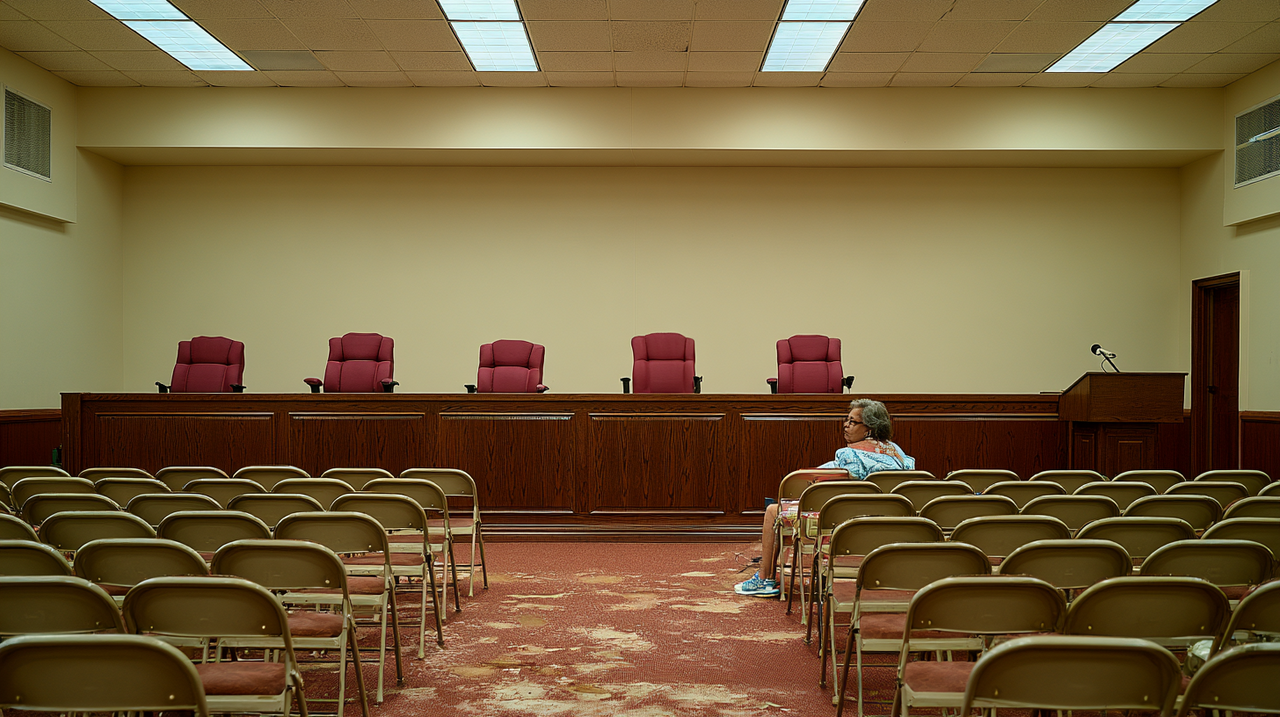
The decisive document in the fight over western Coweta County, Georgia, was not a protest sign or a petition. It was a line on a zoning map. For years, 829 acres of pine and hardwood about thirty-five miles south-west of Atlanta had carried the designation Rural Conservation, a category the county's own comprehensive plan reserved for what it called rural places and complete communities. In April 2026, on a three-to-two vote of the county board of commissioners, that land became Industrial. The change took seconds to enact and will take a decade to build out: nine data centre buildings, two substations, a campus valued at seventeen billion dollars and rated at nine hundred megawatts, roughly the output of a nuclear reactor, dropped into a landscape whose defining feature until that afternoon had been that almost nothing was there.
The residents who had spent fifteen months trying to stop it were, by then, extremely well organised. Laura Beth, the chairwoman of a group called Citizens for Rural Coweta, had learned in early 2025 that a hyperscale campus of more than 4.9 million square feet was proposed to run past her back garden, and had started a Facebook group, Stop Project Sail, which TIME reported in July had grown beyond eight thousand members. They read the ordinances. They turned up to every hearing. They had no financial interest in the outcome beyond the water in their wells and the value of their houses. And they lost, by one vote, on a body of five people.
I keep returning to that margin, because it exposes what the national argument about artificial intelligence tends to skip. We debate whether the machines are worth their cost. The question Coweta County actually had to answer was procedural: who possesses the authority to trade a place's groundwater, its grid capacity and its rural character for a facility it did not ask for and will not use? That has an obvious legal answer in most American jurisdictions, and a deeply unsatisfying one. The bodies with formal power to decide are frequently not the bodies containing the people who bear the consequences. The harm has one footprint and the franchise has another, and the AI build-out has made the gap between them impossible to ignore.
A Country Learning to Say No
The gap is being noticed at scale. On 18 July 2026, according to Reuters reporting carried in newspapers across the country, opponents staged 142 protests across 42 states, coordinated by a group calling itself HumansFirst and described as the first nationally organised day of action against the AI build-out. Texas hosted eighteen events, more than any other state; Georgia eleven; California eight. HumansFirst was co-founded by Amy Kremer, a veteran of the Tea Party and of Women for Trump, who has compared the mood to 2009 while insisting the campaign is nonpartisan, and who blames both parties for letting the companies build at this scale without troubling to consult the people who will live beside it.
The protests are the visible edge of something larger. The Information reported in June 2026 that more than three hundred American cities, towns and counties had adopted bans or moratoriums on data centre development. Data Center Watch, the tracker maintained by the AI research firm 10a Labs, counted 833 active opposition groups across forty-nine states by March 2026, up from 396 at the end of 2025, and calculated that in the first quarter of 2026 alone at least seventy-five projects worth a combined 130 billion dollars were blocked or delayed. Taken cumulatively since the start of 2025, the tracker puts the value of projects blocked or delayed at roughly 286 billion dollars.
Public opinion has moved with it. A Reuters/Ipsos poll of 4,531 Americans, published on 11 June 2026, found that just fourteen per cent were comfortable with a data centre being built near them, and that fifty-seven per cent would oppose one in their community, including two-thirds of Democrats and half of Republicans. Only a third agreed that building data centres at the current pace was mainly a good thing. Seventy-seven per cent were worried that AI would make electricity more expensive, and Republicans, Democrats and independents worried about it in close to equal proportion. This is not a partisan split so much as a broad, cross-cutting discomfort, and it has begun to register at the level of state executives. On 14 July 2026, Governor Kathy Hochul signed Executive Order No. 62, imposing what her office described as the first statewide moratorium in the United States on new hyperscale data centres, pausing discretionary state environmental permits for facilities drawing fifty megawatts or more for up to a year while regulators build a framework. New York's average residential electricity price has climbed by close to sixty-eight per cent since 2019. “They drive up costs for local ratepayers,” Hochul said of the facilities, “and I refuse to let those costs get passed down to New Yorkers.”
What happened in New York before that order is the more revealing half of the story, and it is this essay's question in miniature. On 4 June 2026 the state legislature passed the Responsible Data Center Development Act, a one-year moratorium on state permits for data centres drawing twenty megawatts or more, with dedicated rate classes, transparency standards and impact studies attached. The Senate carried it forty-four to sixteen, the Assembly one hundred and two to thirty-nine. Hochul did not sign it. Six weeks later she issued an executive order of her own, and commentators now expect the Act to be vetoed. The thresholds are the tell: the chamber closest to the affected districts drew its line at twenty megawatts, the single executive at fifty, more than twice as permissive. Both instruments are lawful, both get reported as a moratorium, and they are not the same policy. The choice between them was settled by which office holds the pen.
One widely repeated figure deserves care. Reporting on the backlash, including TIME's, has cited electricity price rises of up to 267 per cent in states with dense data centre activity. That number originates in a Bloomberg analysis of wholesale prices at tens of thousands of individual grid nodes, which found that in some locations near major clusters the monthly wholesale cost of power was as much as 267 per cent higher than five years earlier. It is a wholesale, node-level finding rather than a residential bill, and when Senator Elizabeth Warren used it as a household figure in June 2026 PolitiFact rated the claim mostly false. The distinction matters, because the ease with which the number has migrated into the shorthand of the debate is itself a symptom of how little reliable, locally specific information reaches the people asked to accept these facilities.
The Difference Between By-Right and By-Permission
To understand where authority actually sits, you have to understand a distinction almost nobody outside land-use law thinks about until it lands on them. In American zoning, a use is either permitted by right in a given district, meaning a developer who meets the technical standards is approved administratively through site-plan review, or it requires a discretionary act, a rezoning or special exception, which triggers public hearings and a legislative vote.
For most of the industry's history, in most of the places it grew, it was by right. Loudoun County, Virginia, the densest concentration of data centres on earth, permitted them by right across much of its industrially zoned land, which is precisely how the corridor filled so fast and so quietly. That changed on 18 March 2025, when the board of supervisors voted seven to two to make data centres a special exception use in districts where they had been by right, converting an administrative rubber stamp into a legislative process with staff review and public hearings. Even then, the board grandfathered applications submitted before 12 February 2025 for projects more than five hundred feet from homes. The reform arrived after the pipeline had already formed.
The by-right question determines whether there is a public decision at all. Where a data centre is by right, there is no hearing to attend, no vote to lobby, no record to appeal. The community's only formal opportunity to shape the outcome came years earlier, when the zoning map was drawn, in a proceeding almost nobody attended because nobody imagined what would eventually be built there. The decision had, in effect, already been taken by the county's past self on behalf of its future one.
Where discretion does exist, the procedural rules become the whole battlefield. The most consequential legal defeat the industry has suffered in Virginia turned on a technicality of notice. On 7 August 2025, Prince William County Circuit Court Judge Kimberly Irving voided the rezoning for the Prince William Digital Gateway, a project of more than two thousand acres beside the Manassas battlefield, holding the ordinances void ab initio because the county had failed to comply with the state code's public-notice requirements: the advertisement for the December 2023 hearing was published three days before it. The Court of Appeals of Virginia affirmed unanimously on 31 March 2026. The county and the developer Compass Datacenters withdrew from the litigation in April. QTS, the Blackstone-owned operator, petitioned the Supreme Court of Virginia in May through an affiliate, then withdrew the petition on 2 July 2026, leaving the lower rulings standing, and after a Court of Appeals order on 29 July the rezonings are void and the land reverts to the district it held before. The largest data centre campus ever proposed in the United States, some 2,100 acres of it, is dead. Years of civic argument about water, viewsheds and historic land hinged on the calendar arithmetic of a legal notice, because that was the only lever the law actually handed the objectors. The lever worked. The project was not defeated on water, or on viewshed, or on any ground the community had spent years assembling. It was defeated on the date a newspaper advertisement ran.
Ken Confidential
The second structural feature that determines who decides is information, and here the asymmetry has been engineered deliberately. In July 2026, Public Citizen published a report by Deanna Noël titled The Secret Data Center Buildout, documenting the routine use of non-disclosure agreements between developers and the public officials who will vote on their projects. It found that eighty per cent of Virginia localities with proposed or existing data centres have NDAs in place, and that at least ten states have introduced bills restricting the practice. Some agreements forbid officials from revealing that discussions are occurring, that confidential information has been received, or even that an NDA exists.
The Minnesota Star Tribune documented the same machinery in its own state, reporting that eight cities, two counties, at least one state agency and a school district had signed such agreements; of twelve cities the paper approached with known data centre proposals, only four had never signed one. Leslie Krueger, the University of Minnesota's assistant vice president for planning, space and real estate, spent August 2023 corresponding about Meta's Rosemount campus, code-named Project Bigfoot, with a company representative who identified himself to her only as “Ken Confidential”. Further north, in Hermantown near Duluth, city officials knew from September 2024 that a large project was proposed and declined to confirm publicly what it actually was until the Star Tribune obtained the city's emails roughly a year later, at which point the scheme filed as Project Loon turned out to be Google's. A community can be kept from knowing not merely who is building but what is being built, for a year, by the officials it elected. In Tucson, negotiations over a 290-acre campus proceeded for roughly two years behind NDAs that concealed the end user's identity from the public and from most of the city council. “Giant corporations prefer to operate in the shadows,” the council member Lane Santa Cruz said, “but Tucson is not for sale. We deserve transparency and accountability.”
Coweta County shows how the two asymmetries compound. Investigative reporting by DeSmog, based on public records requests, established that Project Sail's public face, an entity called Atlas Development, LLC, was fronting for Prologis, the San Francisco-based logistics real estate giant, whose involvement was concealed until May 2025 even as its logos appeared on project illustrations. The records showed a steady programme of private access: a meeting between a Prologis vice-president and one commissioner at a Newnan law office in July 2025, another with a second commissioner in August, personalised email updates to all five the day before a public hearing, further emails in October. The lobbyist Arthur “Skin” Edge IV submitted recommendations for the county's data centre ordinance on 7 July, writing that he did so on behalf of the Project Sail team and stating that Atlas Development had retained him as an attorney for the project; both Atlas Development and Prologis subsequently told DeSmog that they were not represented by Edge. Somebody's account of who was speaking for whom is wrong, and the instructive part is that the public record does not allow anyone outside those rooms to establish whose. After a CBRE vice-president testified at the November 2025 hearing, commissioners amended their draft to allow data centres on collector roads, raise the height limit from sixty to seventy feet, and replace a requirement that utilities demonstrate adequate capacity with a letter of intent showing preliminary coordination.
Set against that, Laura Beth's account of her group's access is stark. “Coweta County has not met with us specifically about the ordinance,” she told DeSmog, describing commissioners who would accept only group emails and declined the telephone conversations residents requested. The rules governing the facility were being drafted in one conversation and defended in another, and only one of those conversations had a transcript.
The Lawsuit That Followed the Vote
Suppose a community clears every hurdle: it learns about the project in time, secures a discretionary hearing, persuades its elected board, and votes no. What happens then is the sharpest test of where authority really lies, and the answer arrived in a farming township of about 2,200 people in Washtenaw County, Michigan.
In September 2025, after months of contentious meetings, the Saline Township board voted four to one to deny the rezoning sought for a Stargate data centre campus backed by Related Digital, Oracle, OpenAI and Blackstone, with DTE Energy contracted to supply roughly 1.4 gigawatts. Two days later the developers and landowners sued, alleging exclusionary zoning: the claim, under Michigan law, that the township had unreasonably barred a legitimate use, strengthened by the fact that Saline Township had no industrially zoned land at all. Facing litigation costs against an annual municipal budget of roughly a million dollars, the township settled by consent judgment, accepting community benefits worth about fourteen million dollars, including four million for farmland preservation, along with water and noise restrictions. The attorney who advised the settlement observed that zoning power is not absolute.
The sequel is more revealing than the settlement. Residents organised to force a referendum on the rezoning, a right Michigan law affords them. On 14 January 2026 the board formally rezoned the land to industrial to comply with the consent judgment; on 28 January it reversed that action and restored the agricultural designation, reasoning that the judgment itself authorised the project, so no map change was required. Because there had been no formal rezoning, there was nothing to petition against. Tammie Bruneau of the Rural Michigan Defense Fund put the consequence plainly: if the map need not be updated and no notice published, there could be no referendum. The resident Kathryn Haushalter, whose motion to intervene in the settlement had been rejected by a Washtenaw County judge as untimely, asked the question the episode poses: “What does it look like when residents are not able to determine what happens in their communities? What are we expected to do?” On 1 June 2026, Governor Gretchen Whitmer and Sam Altman appeared at the ceremony marking construction of the campus.
Tucson demonstrates the same lesson through geography rather than litigation. On 6 August 2025 the city council voted seven to nil to reject the annexation that Project Blue required, after residents objected to roughly two thousand acre-feet of city water a year. But the land was unincorporated county territory, and the Pima County board of supervisors had already voted three to two in June to sell it and had approved the zoning. The developer, having earlier signalled that the project could not proceed without the city, redesigned the facility for air cooling, which uses far less water and considerably more electricity, and pressed ahead through the county alone. On 3 December 2025 the Arizona Corporation Commission approved the power purchase agreement four to one, Commissioner Rachel Walden the sole vote against; Tucson Electric Power expects to be supplying the campus with two hundred and eighty-six megawatts by 2028. Amazon Web Services withdrew as operating partner. The project continued, and then acquired one more venue. Arizona's attorney general, Kris Mayes, has appealed the commission's approval, contesting the speed of it and arguing that the agreement lets the utility and the developers set electricity rates between themselves, a power the state constitution reserves to the commission alone. For once the proliferation of forums runs in the objectors' favour, though nobody in Tucson could reach that one either. The state's chief legal officer took an interest, which is a different thing from a community having a say.
The pattern in both cases is not that local government was overruled. It is that “local government” was never a single thing. It is a set of overlapping venues — township, county, court, utility commission — in which a developer need prevail only once, while residents must prevail everywhere.
Where the Decision Actually Lives
Step back far enough and the venue keeps moving upward. Justin Kollar, writing in the Journal of the American Planning Association in 2026, describes this as planning under pre-emption: states removing land use, zoning and environmental review authority from cities and counties through statutory overrides, utility governance, fiscal incentives and procedural constraints, so that decisions migrate to state agencies, utilities and corporate actors, and planning becomes administrative coordination rather than deliberation.
West Virginia has gone furthest. Its House Bill 2014 bars counties and municipalities from adopting or enforcing any ordinance limiting a certified microgrid district or a certified high-impact data centre, and exempts those projects from county and municipal zoning and land use ordinances, from building permitting, inspection and code enforcement, and from licence requirements. What is left to the locality is the power to charge fees and to send fire engines and police cars. Nor does the statute restrict what may be generated inside a microgrid district, so a gas, coal or nuclear plant may be sited in a county that has been relieved of any authority to review it. And the property tax revenue such a facility produces does not stay where the facility stands: the statute routes the greater part of it to the state, partly to fund reductions in income tax. That last provision repays attention, because the standard defence of accepting a data centre is that the host is compensated for what it absorbs. West Virginia has legislated away the deliberation and the compensation together, and left the county with the facility. In Pennsylvania, a proposed Data Center Siting and Permitting Act would have the state environmental department designate at least fifteen pre-approved sites. More than three hundred data-centre-related bills were introduced by state legislators in the first six weeks of 2026.
Much of the most consequential decision-making never touches land use at all. It happens at public utility commissions, bodies whose members most residents cannot name. On 15 April 2026 the Louisiana Public Service Commission voted four to one on Entergy Louisiana's application to build the generation for Meta's Richland Parish campus: seven new gas-fired power stations, some two hundred and forty miles of transmission and a set of nuclear uprates, a programme of 21.37 billion dollars, the largest investment in the utility's history, binding ratepayers across the state for the term of a twenty-year agreement. What the commissioners approved that day was not the plan. It was a request to fast-track it, skipping key steps of the standard regulatory review; the vote on the application itself is set for November 2026. The distinction is this essay's subject reduced to a single procedural motion. Before anybody decides the question, somebody decides how much deliberation the question is going to get, and that second decision is taken first, in a proceeding almost nobody is watching. Entergy maintains that Meta will cover construction costs and that customers will save money. The Alliance for Affordable Energy has warned that if Meta departs before the contract ends, the cost of the gas plants could fall on ordinary ratepayers; the Union of Concerned Scientists noted that the commission declined to investigate a financing arrangement under which Meta established an additional parent entity, retaining a twenty per cent stake, and borrowed twenty-seven billion dollars against the project. Whatever one concludes about the risk, a decision of that magnitude about who bears what is being taken by five elected commissioners in a venue with no relationship whatsoever to the parish hosting the buildings.
The tariff question is following the same path. According to Utility Dive, state regulators approved twenty-nine large-load tariffs in 2025, against fourteen in the whole period from 2018 to 2024, and by June 2026 twenty-four states had approved at least one. Minnesota's HF 16, enacted in June 2025, requires the state utility commission to create a very large customer rate class and allocate attributable costs to it. Oregon's POWER Act directs its commission to establish a separate class for facilities of twenty megawatts or more. Texas Senate Bill 6, signed on 20 June 2025, established a regime for loads of seventy-five megawatts and above, requiring new transmission-level connections to install equipment permitting remote curtailment during firm load shed events. These reforms matter enormously for whether the build-out raises household bills. They are also decisions taken hundreds of miles from any affected backyard.
Then there is the fiscal layer, which quietly converts a public choice into an accounting one. Good Jobs First has documented that most states subsidise data centres through sales and use tax exemptions on hardware and software, some lasting as long as forty years, alongside property tax abatements, and calculates that public subsidy runs to roughly two million dollars for every permanent job created. Abatements and payment-in-lieu-of-taxes arrangements are typically negotiated by development authorities rather than legislatures. At the top of the stack sits Executive Order 14318, signed on 23 July 2025, directing federal agencies to streamline permitting, identify federal land for siting and expedite environmental reviews for qualifying projects. Every one of these levers is legitimate in itself. Stacked together, they mean that by the time a proposal reaches a county board, most of the consequential variables have already been fixed elsewhere.
The Boundary Problem in a Rural County
This is where the argument stops being about zoning and becomes something older. Democratic theory has a name for the difficulty at the centre of the data centre fight: the boundary problem. In 1983 the political theorist Frederick Whelan set it out with uncomfortable clarity. Democracy is a method by which a group makes decisions, but it offers no democratic method for deciding who belongs to the group; any vote on the boundaries of the demos must be taken by a demos already constituted, which places the foundational question outside democratic determination. Robert Dahl, who framed the same difficulty a decade earlier, could find no satisfying escape from it.
One candidate answer is the all-affected-interests principle: those affected by a collective decision should have a say in making it. Robert Goodin, examining it in Philosophy and Public Affairs, treated the principle as the most promising basis for constituting a demos while showing how radically expansive it becomes once taken seriously, since almost any decision affects almost everyone at some remove. Sarah Song, writing in International Theory, argued the other way, that the demos should be bounded by the state, precisely because affectedness is too elastic to draw workable lines. The debate is unresolved for good reasons. But the data centre is an unusually clean instance of the mismatch it describes.
Consider the footprints. A hyperscale campus draws on an aquifer that obeys hydrology rather than municipal boundaries; its cooling demand, at the upper end of industry estimates, can reach five million gallons a day, comparable to a city of fifty thousand. Its electrical load falls on a regional transmission system, and PJM's footprint alone spans thirteen states and the District of Columbia. Data centres consumed about 4.4 per cent of American electricity in 2023, according to the Lawrence Berkeley National Laboratory's report for the Department of Energy, and are projected to reach between 6.7 and twelve per cent by 2028. Emissions travel with the wind; xAI sited turbines for its second Memphis supercomputer across the state line in Southaven, Mississippi, while the computing sat in Tennessee. Ratepayer costs fall on a customer class defined by a utility's service territory. Not one of these footprints coincides with the electorate of a county board of commissioners.
The subsidiarity principle, familiar from European constitutional law and Catholic social teaching, holds that decisions should be taken at the lowest level competent to take them. It is usually invoked for localism, and here it is often assumed to settle the matter in favour of the county. But subsidiarity contains its own limit, and the limit is competence. A township of 2,200 people cannot competently allocate a regional grid's capacity, and should not have to. Equally, a state utility commission cannot competently decide what a particular hillside means to the people who live beneath it. The failure is not that decisions are made too high or too low, but that they are distributed across levels in a way that lets each venue treat the questions it is worst placed to answer as somebody else's problem.
Elinor Ostrom, whose fieldwork on commons governance won her the Nobel prize in economics in 2009, derived design principles for institutions that manage shared resources without collapsing. Two are directly relevant: that the boundaries of the resource and of the group entitled to use it be clearly defined and congruent with local conditions, and that most individuals affected by operational rules be able to participate in modifying them. Measured against those principles, American data centre siting fails not because it is too democratic or too little, but because the people bound by the rules and the people entitled to change them are systematically different sets of people.
The Strongest Case Against the Veto
It would be easy, and dishonest, to leave the argument there. The case for local control over land use has a bleak record, and anyone who wants to strengthen community authority over data centres should sit with it.
The most rigorous account is Neighborhood Defenders, the 2019 study by Katherine Levine Einstein, David Glick and Maxwell Palmer, which examined thousands of participants in local land-use proceedings and found that the people who turn up to oppose development are not representative of their communities. They are disproportionately older, whiter, wealthier and far more likely to be homeowners; they oppose new housing considerably more strongly than their neighbours do; and the participatory institutions built to democratise planning reliably amplify their voices. The result has been a decades-long housing shortage borne overwhelmingly by people who never got to attend the meeting because they did not yet live in the town.
The same dynamic has kneecapped the energy transition. The Sabin Center for Climate Change Law at Columbia found that by the end of 2024 at least 459 counties and municipalities across forty-four states had adopted severe local restrictions on siting renewable energy, a sixteen per cent rise in a year, and identified 498 contested projects across forty-nine states. Between 2018 and 2023, at least thirty per cent of utility-scale wind and solar projects were cancelled during siting, largely because of community opposition, local ordinances and zoning. If your principle is that affected communities may refuse infrastructure they did not choose, that principle has already been road-tested, and used most effectively against solar farms and transmission lines.
The pro-build response also has a legitimate core. Matthew de Boer, writing in the Fordham Law Review in 2026, notes that states have aggressively pursued data centres with incentives while declining to regulate their siting, leaving municipalities to manage hyperscale facilities with frameworks designed for warehouses. His proposal is light pre-emption modelled on housing reform: not the elimination of local authority but its discipline through procedural mandates and objective standards. The Michigan exclusionary zoning doctrine that defeated Saline Township exists for a reason. A jurisdiction with no industrial zoning anywhere within it has, in effect, pre-committed to refusing every industrial use, and a legal system that permitted that at every boundary would make nothing buildable anywhere.
The honest position, then, is that “who decides” genuinely cuts both ways, and that a general right of local veto is not a principle anyone should want applied consistently. Which is precisely why the boundary problem is the right frame. The complaint from Coweta County and Saline Township is not, at its strongest, that localities should be able to refuse anything. It is that the procedure by which these decisions are made produces answers no defensible theory of authority endorses: hearings held after entitlements are secured, ordinances drafted by the applicant's lobbyist, referendum rights extinguished by declining to amend a map, consequences distributed across airsheds, watersheds and ratepayer classes that no ballot anywhere encompasses. That is not the tyranny of the neighbourhood defender. It is the absence of any forum in which the actual question can be put.
Making the Franchise Fit the Footprint
What would it take for a decision of this kind to be legitimate rather than merely lawful? The reforms already circulating are more modest than the theory suggests, and worth taking seriously precisely because they are achievable.
The first is informational, and nearly consensual. Public Citizen's recommendations amount to a simple proposition: officials should not sign non-disclosure agreements with private developers about matters they will later vote on, developers should disclose their identity, projected water and energy use, procurement plans and financial incentives before entitlements are granted, and existing agreements should be published. Attorneys quoted in reporting on Oklahoma's secrecy deals have questioned whether such agreements are even enforceable against public bodies. Pima County changed its own policies on NDAs and environmental review in September 2025, after what its supervisors called lessons learned from Project Blue. And the standard objection, that transparency of this kind is commercially unworkable, has now been answered by the only sort of party who could answer it. On 18 March 2026 Microsoft announced that it would stop using non-disclosure agreements with local governments for data centre projects anywhere in the world and would terminate those already in force, saying that transparency with the communities where it operates was paramount. That followed a commitment in January to pay the full cost of the power its facilities draw, decline local property tax breaks, replenish more water than it consumes and invest in local training. Microsoft is so far the exception, and should be called one: Public Citizen records that every other major technology company continues the practice. A single exception is still enough to dispose of the claim that the practice is necessary. Nothing about the AI build-out requires that the people voting know less than the people lobbying them.
The second is jurisdictional, and follows from the boundary problem. If the harms of a facility cross municipal lines, notice, standing and formal comment rights should cross them too. There is no technical obstacle to requiring that a rezoning application within a defined radius of a boundary trigger notice and consultative standing for the adjacent jurisdiction, or that a groundwater withdrawal above a threshold trigger review at the level of the aquifer rather than the parcel. That would not give neighbours a veto. It would give them a seat, the minimum the all-affected-interests principle can be read to demand without becoming unbounded.
The third is fiscal, and has the most momentum. Large-load tariffs and dedicated rate classes of the kind Minnesota, Oregon and Texas have adopted move the ratepayer question into a proceeding where it can be argued explicitly. If a facility's grid costs are ring-fenced to the customer that causes them, the county board's decision becomes one about land, water and noise rather than about everyone else's electricity bill, and the venue mismatch shrinks. The same logic applies to abatements: a forty-year tax exemption negotiated by a development authority binds successor councils and their electorates, and ought to require the deliberative treatment any long-dated public borrowing would.
New York's executive order is a hybrid of all three. It pauses state permits, an exercise of upward authority, while directing Empire State Development to publish a community investment framework within sixty days to guide local negotiations, and the Department of Public Service to prepare a generic environmental impact statement so proposals are assessed against a consistent standard rather than each locality improvising. Whether that produces better decisions or merely relocates them is unclear. That it exists in place of the statute the legislature actually passed, and at more than twice the legislature's threshold, is a reminder that the reforms are governed by the same question as the projects. But it recognises that a county board asked to evaluate a nine-hundred-megawatt load with a planning staff of a dozen is not being empowered. It is being handed a decision it has no capacity to make and then blamed for the outcome.
A Judge in Newnan
On 5 May 2026, Citizens for Rural Coweta filed a petition in Coweta County Superior Court asking a judge to declare the rezoning invalid. Their argument is that the commissioners disregarded the county's own comprehensive plan, which designated the land for rural places rather than industry, and did so despite the site's groundwater recharge areas, wetlands and watershed. It is, in essence, a claim that the county broke a promise to itself.
There is a coda to the vote that is easy to miss, and it may be the sharpest thing in this account. In May 2026, weeks after rezoning the Sargent land, the Coweta commissioners adopted a moratorium on any future data centre project in the county. Residents said it was too little and far too late; one likened it to shutting the barn door once the horses were out. But consider what the sequence establishes. The county was entirely capable of pausing. It held the instrument, understood how to use it and did use it, one decision after the only decision that mattered. Coweta's future self is now protected in a way its present self declined to be, and the difference between those two counties is not one of law, or capacity, or information, or public sentiment. It is a difference of timing, which is to say a difference of nothing at all except that the applicant arrived first.
The venue is telling. Having lost in the only forum where they could vote, the residents have moved to the one forum where nobody votes at all. That is the recurring shape of these disputes. In Prince William County the decisive intervention was a judge's reading of a notice statute, and it killed the largest project in the country. In Saline Township a consent judgment did what the electorate had refused to do, and a second judge declined to reopen it. In Tucson a unanimous rejection was routed around by a county land sale and a corporation commission vote, and the next serious challenge came from a state attorney general. Litigation has become the default civic instrument of the AI build-out because it is the only instrument that reliably crosses the boundaries everything else respects.
There is a version of this story in which the residents are simply wrong: in which a county gains a tax base and a state gains capacity it badly needs, and a few hundred households absorb a view they dislike, which is roughly what infrastructure has always asked of somebody. I do not think that version is obviously false. What is false is the assumption that the current procedure is capable of telling us which version is right. A process in which the applicant's lobbyist helps draft the ordinance, the developer's identity is concealed behind a shell entity, commissioners meet privately with one side and by group email with the other, and a referendum right can be extinguished by declining to amend a map, is not a process that produces a trustworthy answer to a hard question. It produces an answer and calls it settled.
The families in Coweta County who moved out of Atlanta to be surrounded by trees are not, in the end, asking for a veto over American AI policy. They are asking something democratic theory has never fully answered and American land-use law has stopped even trying to: what makes a decision about a place belong to the people who live in it. Nine hundred megawatts is arriving either way. Whether it arrives as something a community decided or as something that happened to it is a difference no amount of tax revenue will retire, and it is being settled right now, county by county, in rooms that most of the affected will never enter.