Twenty-three thousand a month. That is roughly how many illegal drone flights the New York City Police Department says it logs, a figure that works out at more than 750 a day, or one every couple of minutes, in a city whose own administrative code forbids most drone take-offs and landings outright.
The number sits near the top of a report published in September 2026 by the Police Executive Research Forum, a Washington-based think tank that has been studying American policing since 1976. On 19 September, the New York Times put the report in front of a much wider audience. Reporters Hurubie Meko and Maria Cramer described the forum's warning that the confluence of rapidly advancing artificial intelligence and cheaper, deadlier drones posed an increasing threat to cities and towns across the United States. Unauthorised drones, the paper noted, were flying into football stadiums on game days. Hundreds had been seized near World Cup matches over the summer. And the forum's executive director, Chuck Wexler, reached for the heaviest comparison available to an American policing body in the 25th anniversary year of the attacks on New York and Washington. “Twenty-five years ago, our nation paid a terrible price for a failure of imagination,” he wrote. “We cannot afford to make the same mistake again.”
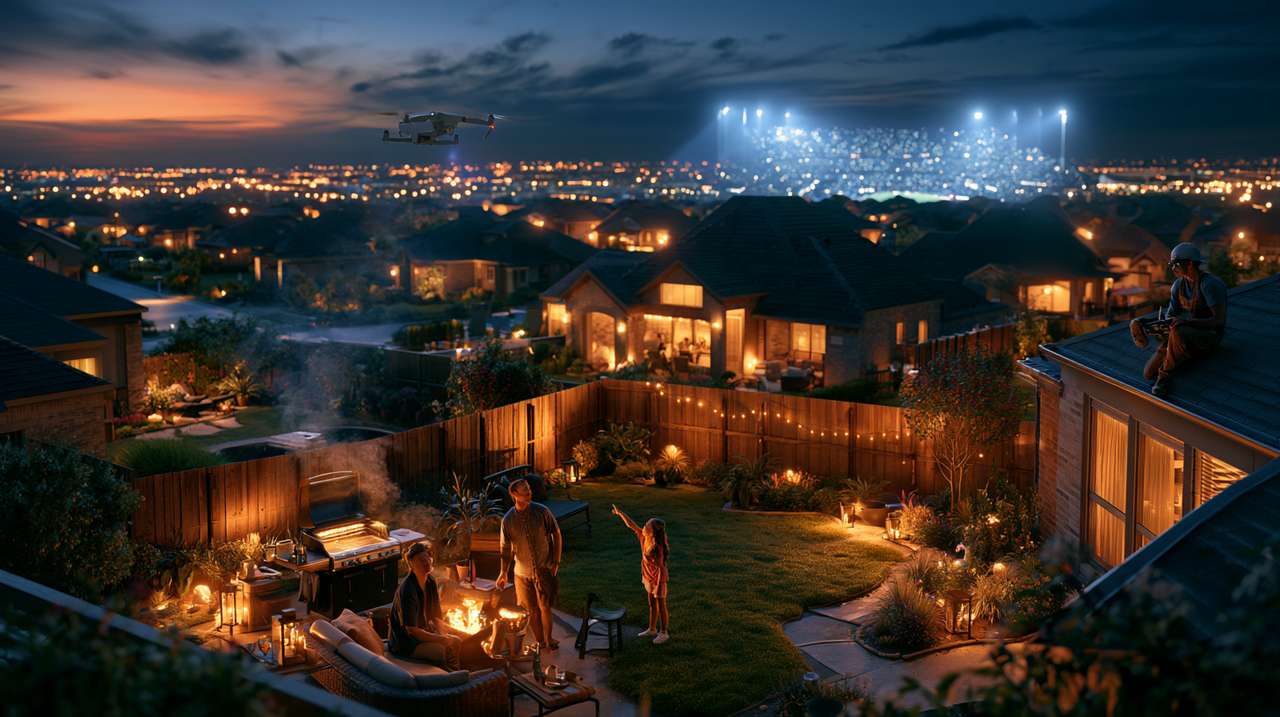
The report's title, “A Clear and Present Danger: The Rise of Malicious Drones and What Police Executives Can Do About It”, makes its position plain. But a warning of this kind is never only about the worst case. It also shapes how ordinary people experience the sky over their heads: what a buzzing rotor at a barbecue means, who gets stopped at a stadium gate, whether a delivery drone over the fence is a convenience or an intrusion, and whether the police drone hovering above a street party is a guardian or a watcher. So two questions follow. What changes for life in the spaces below, in stadiums, streets, parks and back gardens, when cheap autonomous flight guided by AI becomes part of the everyday urban environment? And is this kind of warning the necessary exercise of imagination its authors call for, or a drumbeat that teaches the public to fear the sky?
What the Police Report Actually Says
Start with the document itself, because it is more careful than its headline. The report is the 57th in the forum's Critical Issues in Policing series, a long-running programme supported by Motorola Solutions and the Motorola Solutions Foundation. It draws on a meeting of roughly 150 police executives, federal officials and industry representatives held in Washington in May 2026, and on questionnaire responses from 269 law enforcement agencies gathered several months earlier.
Its headline numbers are stark. The National Football League reported 2,800 drone incursions into the restricted airspace around its stadiums during the 2025 season. The NYPD reported an average of about 23,000 illicit drone flights a month. And during the FIFA World Cup in June and July 2026, federal and local authorities seized more than 700 drones near stadiums and fan festivals across the 11 American host cities. Wexler's foreword argues that “we should not mistake the absence of an attack for the absence of a threat”, and that 700 incursions in a matter of weeks show how commonplace unauthorised flying has become even around the most heavily secured airspace in the country.
Read on, though, and the report supplies its own counterweight. Of the World Cup seizures, it states plainly that there were no reports that any of the drones had been turned into weapons, and that nobody had been charged with a crime related to their use, although, as described below, at least one Dallas-area operator has since been reported to face federal charges. It concedes that the United States has not experienced even the small-scale drone attacks that have caused injuries elsewhere in the world. And in one of its most revealing passages, Micheal Torphy, an assistant section chief in the FBI's Unmanned Aviation Section, explains to the assembled police chiefs that Remote ID, the electronic licence plate that most registered drones are required to broadcast, will catch only the “careless and clueless”, meaning hobbyists who stray into restricted airspace without meaning to. “But that's about 99.5 percent of people that we encounter,” he said, “so you have a 99 percent solution.”
That is the paradox at the centre of the debate. The report's numbers describe a sky full of rule-breakers, almost all of whom are not dangerous. Its argument concerns the tiny remainder who might be.
As for artificial intelligence, the technology that gave the New York Times its headline, the report itself says surprisingly little. In his foreword, Wexler notes that after his visits to Ukraine he observed that some drones are now guided by artificial intelligence, “allowing them to operate with little or no active signal to intercept”, while others are steered through fibre-optic cables stretching for miles. The New York Times added that Ukrainian officials had said an AI-guided Russian drone killed three people when it crashed into a wall and exploded. The concern is specific and technical: counter-drone systems have been built to detect and jam the radio link between a pilot and an aircraft, and a drone that can find its own way does not need that link.
Twenty-Three Thousand Flights and What the Number Hides
To understand the most quoted figure, it helps to know what makes a drone flight illegal in New York. Section 10-126© of the city's Administrative Code has long prohibited most take-offs and landings of unmanned aircraft within city limits. A 2023 rule created a permit route administered by the NYPD with the city's Department of Transportation, and model aircraft fields designated by the parks department are exempt. Almost every flight launched from a rooftop, a park lawn or a garden without a permit therefore breaks the law, whatever its purpose.
Seen this way, 23,000 a month is less a measure of menace than a measure of how far a near-total ban has drifted from the behaviour of a city of more than eight million people with cheap cameras that fly. The report itself notes that consumer drones with video capability can be bought for well under $100. By the FBI's own estimate, the overwhelming majority of operators that officers encounter are careless and clueless rather than hostile, and when federal agents examined the drones seized during the World Cup, as described below, that is broadly what they found.
None of this means the number is meaningless. A city where tens of thousands of unpermitted flights take place each month is a city where a single hostile flight is very hard to pick out of the background noise. That is precisely the police argument, and New York's police commissioner, Jessica Tisch, has made it in the starkest terms: “If there is one threat that keeps me up at night, it is from drones.” But a statistic that sounds like evidence of a looming threat is, in large part, evidence of a regulatory mismatch.
Match Day Under a Three-Mile Ceiling
Stadiums are where the abstract threat becomes concrete, and where ordinary fans are most likely to feel the change. Since 2021, according to the report, every NFL stadium has been required to deploy technology capable of detecting, tracking and locating drones on game days. Cathy Lanier, the league's chief security officer, told the forum that security teams deal with at least a dozen drone incursions every game. When one is detected, she said, it automatically connects with the stadium camera, which swings round to look at it.
College football has the same problem at greater scale. Sean Patterson, police chief at the University of Tennessee, described a drone that hovered over the 40-yard line during a sold-out Luke Combs concert at Neyland Stadium in 2026 and was not picked up by the venue's software. “That could have something as simple as a grenade on it,” he said. “My stadium's over 100 years old; I'm not getting those 80,000 people out.” William Thompson, deputy chief of police at the University of Notre Dame, put the geometry bluntly: “It is literally 300 yards from the south wall of my stadium across the city line to parking lots where people could launch anything.”
Torphy offered the most unsettling observation of all. “In traditional security culture, the more gates and more guns you have, the more protected you are from the traditional attack methodologies,” he said, “but the more vulnerable you are to attack from above.”
The World Cup showed what the response looks like in practice. The Federal Aviation Administration declared temporary flight restrictions with a radius of three nautical miles around stadiums on match days and one nautical mile around fan festivals. Operators who strayed inside faced fines of up to $100,000, criminal charges and confiscation of their aircraft. Agencies seized drones in every host city, though the city-by-city tallies reported by different federal bodies do not agree with one another, a small reminder of how hard the airspace is to count.
Who were the people whose drones were seized? In Dallas-Fort Worth, where the three-mile ring around AT&T Stadium took in residential neighbourhoods and businesses, NBC's local investigative team reported that the seizures included real estate photographers and roofing inspectors. Kevin Vest, an assistant special agent in charge at the FBI's Dallas field office, said: “Many of the operators have told us they're doing it to get an aerial view of the stadium, of the crowds, of the marches.” The FBI confirmed that none of the seized drones carried dangerous payloads. One man who now faces federal charges had, according to a fundraising page set up by his family, been “just flying near his house and did not know there would be restrictions due to the World Cup”.
This is what the filling sky does to ordinary life around a stadium. A no-fly zone drawn for a global tournament reaches into gardens and driveways three miles away. A roofer's survey becomes a federal matter. The defensive perimeter that once ended at the turnstiles now extends upwards and outwards over the homes of people who never bought a ticket.
The Police Drone Is Part of the Sky Too
Any honest account of the crowded urban sky has to include the aircraft flown by the police themselves, who are fast becoming some of the busiest drone operators in their cities.
New York is the clearest example. In November 2025, the Surveillance Technology Oversight Project, a New York civil liberties group, reported that NYPD drone flights had risen by 3,200 per cent since 2022, with 6,546 flights in the first six months of 2025 compared with 647 in the same period of 2024. “Drone flights have skyrocketed . . . and we didn't talk much about it or know much about it,” said Eleni Manis, the group's research director. A December 2024 report by the Office of the Inspector General for the NYPD found that the department “does not fully and accurately describe” the capabilities of its drones, which include night vision, thermal imaging and 3D mapping.
The back garden first entered this debate in New York in 2023. Ahead of the Labor Day weekend, Kaz Daughtry, then an assistant commissioner, announced that police drones would respond to complaints about large gatherings, including private parties in back gardens, to “go check on the party to make sure if the call is founded or not”. Daniel Schwarz of the New York Civil Liberties Union called the plan discriminatory and potentially unconstitutional, pointing out that it coincided with the Caribbean J'ouvert celebrations.
Police drones also fall out of the sky. In late June 2026, an NYPD drone, a Skydio model of the kind used in the department's drone-as-first-responder programme, malfunctioned and fell near the World Cup fan zone at Brooklyn Bridge Park, where its lithium-ion battery caught fire. Firefighters dealt with it, nobody was hurt, and the fan zone stayed open. According to DroneXL, it was the second NYPD drone to catch fire in Brooklyn in just over a year. Skydio said it had found no evidence of a safety malfunction in the flight logs.
In Boston, the police department announced a drone-as-first-responder pilot on 28 August 2026, in partnership with Motorola Solutions and the drone maker BRINC. Commissioner Michael Cox said that “putting eyes on a scene in as little as a minute” would help dispatchers send the right resources. Six days later, on 3 September, one of the aircraft fell on to a parked Mazda in Brighton, damaging its rear windscreen and boot. The owner was not at home. Neither the department nor BRINC publicly disclosed the cause.
These incidents are minor, but they show that the drone most likely to fall into a crowd or on to a car is not necessarily a terrorist's, and that the institutions asking for powers to police the sky are among its busiest users. Motorola Solutions, which supports the forum's report series, is also a commercial partner in Boston's drone programme. There is no suggestion that this shaped the report's conclusions, but readers weighing a call for urgent investment in the technology of policing the sky might reasonably want to know it.
Back Gardens and the Law of the Open Sky
For most people, the question of the filling sky is ultimately a question about the garden. Who may fly over it, who may look into it, and what can be done about it?
American law has been answering the looking question for four decades, and the answers have not favoured the homeowner. In California v Ciraolo in 1986, the Supreme Court held that police officers who flew over a fenced garden at 1,000 feet and saw cannabis growing had not carried out an unlawful search, because any member of the public flying in that airspace could have seen the same thing. Three years later, in Florida v Riley, the court applied similar reasoning to a police helicopter at 400 feet looking through gaps in a greenhouse roof. Those cases concerned crewed aircraft, which are expensive and noisy. A drone can do the same job more cheaply, more quietly and from lower down.
The courts are only beginning to catch up. In Long Lake Township v Maxon in 2024, the Michigan Supreme Court considered a township that had hired a drone operator to photograph a couple's property, which could not be seen from the road, in a dispute over junked cars. The court declined to decide whether the flights amounted to a search, ruling instead that the exclusionary rule did not apply to civil zoning enforcement, so the images could be used whatever the answer.
Homeowners trying to take matters into their own hands have found the law equally unclear. In 2015, William Merideth of Hillview, Kentucky, shot down a drone hovering over his family's garden with a shotgun, saying he believed it was spying on his daughters. The drone's owner, David Boggs, disputed his account. A Bullitt County judge dismissed the criminal charges against Merideth, and a federal judge later dismissed Boggs's civil suit for lack of jurisdiction, without settling who owns the air above a garden. Local councils have had little more success. In 2017, a federal court in Massachusetts struck down provisions of an ordinance in the city of Newton that would have banned drone flights below 400 feet over private property without the owner's permission, holding that they conflicted with federal control of the airspace.
The new counter-drone regime adds another layer. Under the SAFER SKIES Act, passed as part of the defence authorisation bill in December 2025 and given effect by an interim federal rule from 1 July 2026, accredited state and local agencies can for the first time detect, and eventually disable, drones themselves. The report stresses that the rule carries privacy, data-handling and retention requirements, and that operators must avoid monitoring content or communications in ways that would violate the First Amendment. But it also shows how detection infrastructure tends to spread. Kevin Crowley, a lieutenant with the University of Michigan police, described a statewide drone association in which detection data from about 32 agencies is being integrated by a third-party vendor, and a planned historical search function. “So if I had a flight on the Ann Arbor campus, I could search that serial number,” he said, and then see the same aircraft's activity in Detroit, East Lansing or Grand Rapids.
For a security professional, that is sensible intelligence sharing. For a hobbyist who flies at the weekend, it is the beginning of a movement log. When the threat is framed as a clear and present danger, systems built to find the rare bad actor end up recording the routine flights of everyone else.
The Delivery Drone Over the Fence
The policing debate concerns a few thousand rogue aircraft. The commercial build-out concerns millions of routine flights, and it is the change most likely to reach the average garden first.
Wing, the drone delivery company owned by Google's parent Alphabet, says its partnership with Walmart aims to reach more than 40 million Americans through a network of more than 270 locations by 2027. In August 2026, David Carbon, vice president of Amazon Prime Air, said that “by the end of 2026 we plan to reach customers in nearly 500 cities and towns”. Amazon's MK30 drone has a maximum take-off weight of 83.2 pounds and serves customers within about 7.5 miles of each site.
Regulators are clearing the way. On 28 July 2026, the FAA signed a nationwide finding that drone package delivery, carried out with the noise mitigation set out in its programmatic environmental assessment, would not significantly affect the quality of the human environment. A separate rule, known as Part 108, would allow routine flights beyond the pilot's line of sight. As of mid-September 2026, it was still under review at the White House, with the FAA saying it hoped to publish by the end of the year.
Not everyone accepts that the sky over the suburbs can be signed off so quickly. On 28 September 2026, 15 states, among them California, New York, Michigan, Illinois and Massachusetts, together with a Texas county, asked the US Court of Appeals for the Second Circuit to review the FAA's environmental assessment. They argue that the agency moved ahead “without adequately accounting for the effects of a potentially large expansion of drone deliveries”. California's attorney general, Rob Bonta, said that “environmental justice and thoughtful innovation can and should go hand in hand”.
There is already a detailed record of what happens when delivery drones arrive over gardens, and it comes from Australia. In 2018, Wing ran a trial in Bonython, a suburb of Canberra. Residents organised as Bonython Against Drones and collected more than 1,000 signatures. In July 2019, the ACT Legislative Assembly's Standing Committee on Economic Development and Tourism published its report. Wing told the committee that 91 per cent of the critical feedback it received from the trial related to noise. Describing the noise of its aircraft, the company acknowledged that “it is a unique sound and it really draws attention”. One Bonython resident told ABC News that the first flyover of the day came at a quarter past seven in the morning. The residents' group told the committee: “There is no-one responsible for the noise.” A local dog-training club explained that dogs hear a drone coming from far further away than people do, and the residents' group described a neighbour's dog so distressed that it wrecked her back garden. The committee's conclusion was unambiguous: drone noise “is the single biggest obstacle to community acceptance of drone delivery services”. It also asked the territory government to help Australia's privacy commissioner consider limits on the collection of personal information about people who are not customers.
Laboratory research points the same way. In a 2017 study, NASA Langley researchers Andrew Christian and Randolph Cabell played recordings of small drones and road vehicles to listeners and found that the drones were judged more annoying at the same loudness. The offset was about 5.6 decibels, which contemporary coverage described as roughly equivalent to a car driving twice as close. Public attitudes were wary before deliveries began. A Pew Research Center survey published in December 2017 found that 54 per cent of Americans thought drones should not be allowed to fly near people's homes.
That is the texture of everyday life under a filling sky. Most of it has nothing to do with bombs. It is a whine at 7.15 in the morning, a dog that will not settle, a camera you did not agree to, and a regulatory system in which, as the Canberra residents found, nobody seems to be in charge of the sound.
What Artificial Intelligence Actually Changes
If most of the new sky is mundane, where does AI make a real difference? The honest answer is that it matters most at the extremes: in the hands of the rare attacker, and in the systems built to stop them.
On the battlefield, the shift is well documented. Ukrainian developers have fielded low-cost machine-vision modules, reported to cost around $100 or less, that let a drone recognise and lock on to a target and continue its final approach even after its radio link has been jammed. The Kyiv regional police commander Serhii Bolvinov told the forum's May meeting that “the war in 2022 and the war today are already two different wars”, and described Russian drones steered through fibre-optic cables that leave nothing in the air to intercept. For a police force whose counter-drone tools depend on reading and disrupting radio signals, autonomy is the problem in its purest form. An aircraft that navigates by what it sees, rather than by instructions from a pilot, emits little for a detector to find and gives a jammer nothing to jam.
That is the legitimate core of the warning, and it should not be waved away. The forum's report also records drone attacks well beyond Ukraine: drones launched at an airport in the Democratic Republic of Congo, an off-the-shelf drone carrying a crude explosive device into a state prosecutor's compound in Tijuana in October 2025, and, according to a United Arab Emirates interior ministry official, 2,260 drones launched at the UAE by May 2026 during the conflict with Iran. Closer to home, the US Bureau of Prisons reported 474 drone incursions and sightings in 2024, twenty times the 2018 figure.
But AI cuts both ways in the urban sky, and the everyday consequences mostly come from the defensive side. The Skydio X10 drones flown by the NYPD use 360-degree obstacle avoidance to navigate between buildings, a form of machine autonomy that makes police flights over crowded streets practical. Federal policy is pushing the technology forward and trying to control it at the same time. On 6 June 2025, the White House issued two executive orders on the same day. One, on airspace sovereignty, warned that criminals, terrorists and hostile foreign actors were turning drones into weapons. The other, titled “Unleashing American Drone Dominance”, opened by declaring that drones “are already transforming industries from logistics and infrastructure inspection to precision agriculture, emergency response, and public safety”, ordered a rule enabling routine flights beyond visual line of sight, and directed the Department of Transportation to use AI tools to speed up the review of drone waiver applications.
So the same government that funds counter-drone grants is using algorithms to approve more drones more quickly. That is not hypocrisy; it is what managing a dual-use technology looks like. But it means the filling sky is not something that simply happens to cities. It is being deliberately built.
Imagination or Drumbeat
So is the forum's warning the imagination its authors say it is, or a drumbeat?
The case for imagination rests on solid ground. The 9/11 Commission's verdict, that “the most important failure was one of imagination”, has become part of how American security institutions think about themselves. The report quotes Sarasota police chief Rex Troche making the point vividly: “No one's going to see this coming . . . you could just sprinkle sugar over a crowd. Yell bomb or yell anthrax. You're going to have a stampede.” Kathy Lester, a former Sacramento police chief, said that the absence of an attack so far “is really kind of a miracle”. When people with decades of experience protecting crowds say this, it is not scaremongering in any simple sense. The technical vulnerabilities are real, the international record of harm is real, and the legal gap that left local police able to see a drone but not stop it was real.
The case against comes from an equally serious tradition. In September 2005, the security technologist Bruce Schneier published an essay in WIRED titled “Terrorists Don't Do Movie Plots”. It opened: “Sometimes it seems like the people in charge of homeland security spend too much time watching action movies.” His argument was that vivid, specific scenarios crowd out sober thinking about risk, and that money is better spent on “intelligence and investigation: identifying the terrorists themselves, cutting off their funding, and stopping them regardless of what their plans are”. A drone over the 40-yard line with a grenade attached is about as cinematic as threat scenarios get.
Recent history shows how fear of the sky can do damage without any attack at all. In December 2018, reported drone sightings closed London Gatwick for about 30 hours over the Christmas getaway, affecting around 1,000 flights and 140,000 passengers. Sussex Police arrested a local couple, released them without charge and later paid them compensation. The force closed its investigation in September 2019 without charging anyone. In late 2024, a wave of sightings over New Jersey prompted alarm across the north-east of the United States. Federal agencies, including the FBI and the Department of Homeland Security, eventually concluded that the reports were “a combination of lawful commercial drones, hobbyist drones, and law enforcement drones, as well as manned fixed-wing aircraft, helicopters, and stars mistakenly reported as drones”. In Europe in 2025, some airport incursions, including those that shut Copenhagen in September, were genuine and serious. But Norwegian police investigating a disruption at Oslo concluded that they were “unable to confirm or deny whether the drones were actually observed”.
Troche's sugar-and-stampede scenario contains a lesson its author may not have intended. In that imagined attack, the payload does no harm. The panic does. Fear is not a side effect of a drone attack. It is the weapon. A public that has been taught to see every buzzing rotor as a potential bomb is a public in which the threat of drones is easier to exploit, not harder.
The best reading of the forum's report is that it is both things at once, and that its value depends on which half its readers hear. As a document for police chiefs, much of it is unglamorous and useful: get trained, write a policy, build relationships with federal agencies, report incidents properly, and, first on its list of eight steps, build public support before using new powers. Its own text concedes that none of the World Cup drones was reported to have been turned into a weapon, and an FBI official inside its pages puts the careless and clueless at 99.5 per cent of the people officers encounter. As a public message, packaged with 9/11, a clear and present danger and AI, it becomes something else: a story in which the sky is, by default, hostile.
Imagining the Whole Sky
If the 9/11 Commission's lesson is that institutions must imagine harm before it arrives, then the imagination being asked for here is too narrow. A properly imaginative approach to the filling sky would also picture the other failures it is likely to bring.
It would picture the counter-measure going wrong, as it did in February 2026 near El Paso, when, according to the forum's report, the Department of Defense used a laser to bring down a drone that turned out to belong to US Customs and Border Protection, and the FAA briefly grounded flights at the city's airport. It would picture the police drone falling on to a parked car, or catching fire beside a fan zone. It would picture the serial-number database that begins as a tool for finding the rare attacker and becomes a record of every weekend hobbyist. It would picture the roofing inspector whose drone is seized, the man charged after flying near his own home, and the Canberra dog wrecking a back garden, and the fact that, as one resident put it, nobody was responsible for the noise.
Above all, it would picture the public as participants in governing the sky rather than as an audience for warnings. The forum's report gets closest to this when it puts public trust at the top of its list. Pew's survey points to the opportunity as well as the risk: when asked how they would feel if they saw a drone near their home, 58 per cent of Americans said curious and only 11 per cent said scared. That is not a public already gripped by fear. It is a public still deciding.
That is what is at stake in how these warnings are delivered. The sky over the stadium, the street, the park and the back garden is going to fill whether or not anyone is frightened of it. Delivery networks are scaling, police fleets are growing, and the machines are getting better at flying themselves. The real choice is not between fear and complacency. It is about whether people who live under that sky help write its rules, or simply learn to flinch when something passes overhead.